Strategi Guru PAI dalam Mengembangkan Kecerdasan Emosional untuk Membentuk Karakter Siswa
DOI:
https://doi.org/10.65941/0gc27917Keywords:
PAI Teacher Strategies, Emotional Intelligence, Student CharacterAbstract
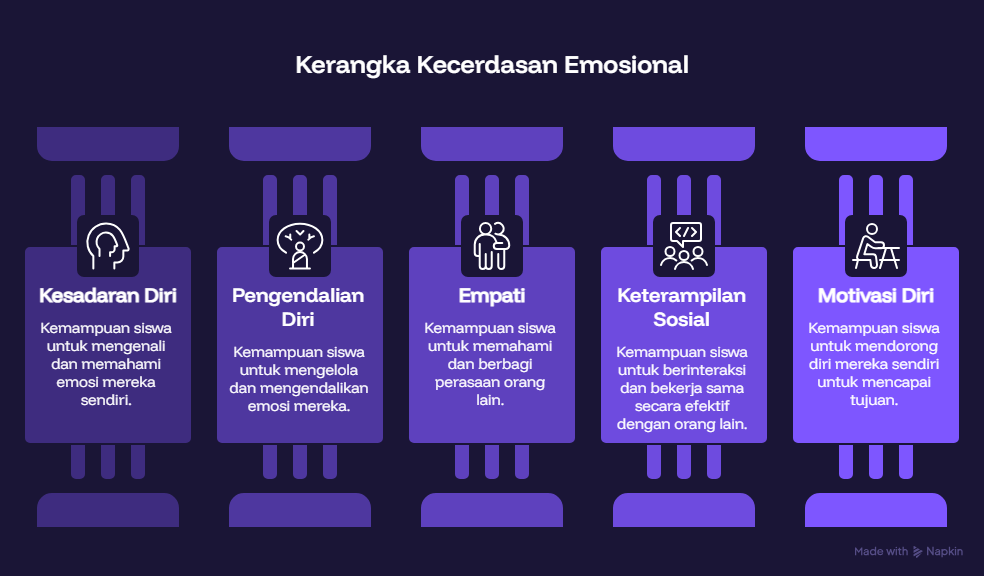
This study aims to analyze the strategies employed by Islamic Education (PAI) teachers in developing students’ emotional intelligence and their impact on character formation at SDIT Multazam, Pamekasan Regency. This research employed a descriptive qualitative approach involving Islamic Education teachers and students selected through purposive sampling. Data were collected through observation, interviews, and documentation, and were analyzed using an interactive model consisting of data reduction, data display, and conclusion drawing. The findings reveal that Islamic Education teachers develop students’ emotional intelligence through role modeling, religious habituation, interpersonal approaches, guidance and advice, and the integration of Islamic values into both classroom learning and school culture. These strategies contribute to students’ ability to regulate emotions, demonstrate empathy, build positive social relationships, and develop disciplined and responsible character traits. The novelty of this study lies in the finding that emotional intelligence development is not limited to classroom instruction but is also fostered through the continuous integration of religious habituation and school culture. These findings contribute to the development of Islamic education by strengthening the role of Islamic Education teachers as facilitators of emotional intelligence and character development through a holistic and school culture-based approach
Downloads
Downloads
Published
Issue
Section
License
Copyright (c) 2026 Shavira Farhaniyah, Enni Alfia Maghfiroh, Moh Riski Aryanto, Emna Laisa (Author)

This work is licensed under a Creative Commons Attribution 4.0 International License.
This journal provides immediate open access to its content under the Creative Commons Attribution 4.0 International License (CC BY 4.0). This license permits unrestricted use, distribution, and reproduction in any medium, provided the original work is properly cited.