Strategi Guru PAI sebagai Motivator dalam Mengembangkan Bakat Keagamaan Siswa
DOI:
https://doi.org/10.65941/68vn3p20Keywords:
Islamic Education Teacher, Religious Talent Development, Student MotivationAbstract
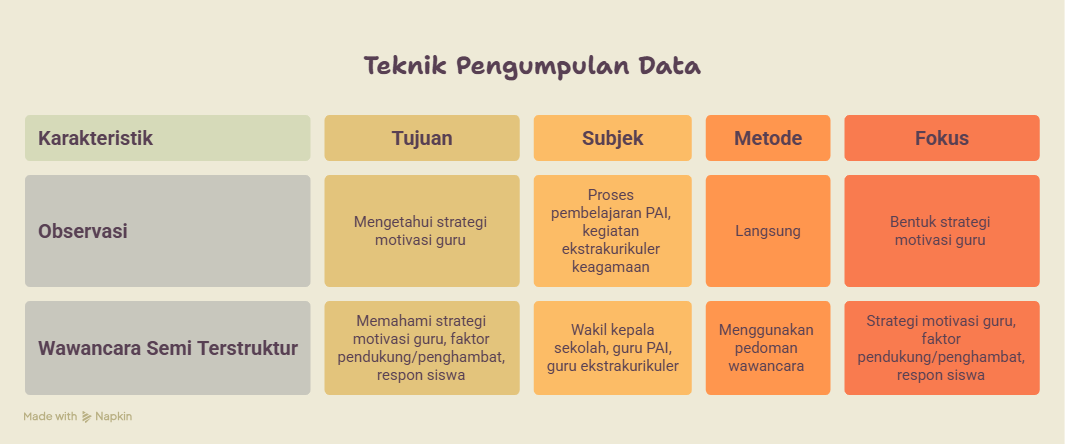
This study aims to examine the role of Islamic Education (PAI) teachers as motivators in developing students’ religious talents at SMP Ma’arif 4 Pamekasan. The research employed a qualitative approach with a case study design. Data were collected through observations, semi-structured interviews, and documentation involving PAI teachers, school leaders, extracurricular coordinators, and students. The findings reveal that PAI teachers play a strategic role as motivators through personal approaches, persuasive communication, positive reinforcement, and the creation of interactive and enjoyable learning environments. These strategies help increase students’ confidence, motivation, and participation in religious activities. The development of students’ religious talents is further supported through the Yanbu’a extracurricular program, which focuses on improving Qur’anic reading skills based on tajwid and makharijul huruf through structured and continuous learning stages. The program also contributes to the formation of students’ religious character through regular habituation activities integrated into the school culture. In addition, the development of religious talents is supported by religious extracurricular activities, digital learning media, and collaboration between schools, pesantren, and parents. However, the study also identified several challenges, including differences in students’ abilities and learning motivation, limited instructional time, low initial Qur’anic literacy, and the lack of a supportive Arabic language environment. To overcome these challenges, teachers implemented individualized guidance, religious habituation, motivational reinforcement, and continuous collaboration with families and pesantren environments. The study concludes that the role of PAI teachers as motivators significantly contributes to the holistic development of students’ religious talents and religious character
Downloads
Downloads
Published
Issue
Section
License
Copyright (c) 2026 Mega Bungah Salsabillah, Robiatul Adawiyah, Moh. Faruk Abdulloh, Windi Wulandari , Emna Laisa (Author)

This work is licensed under a Creative Commons Attribution 4.0 International License.
This journal provides immediate open access to its content under the Creative Commons Attribution 4.0 International License (CC BY 4.0). This license permits unrestricted use, distribution, and reproduction in any medium, provided the original work is properly cited.