Strategi Guru PAI dalam Menanamkan Nilai-Nilai Akhlak Perspektif KH. Hasyim Asy’ari
DOI:
https://doi.org/10.65941/757sjv98Abstract
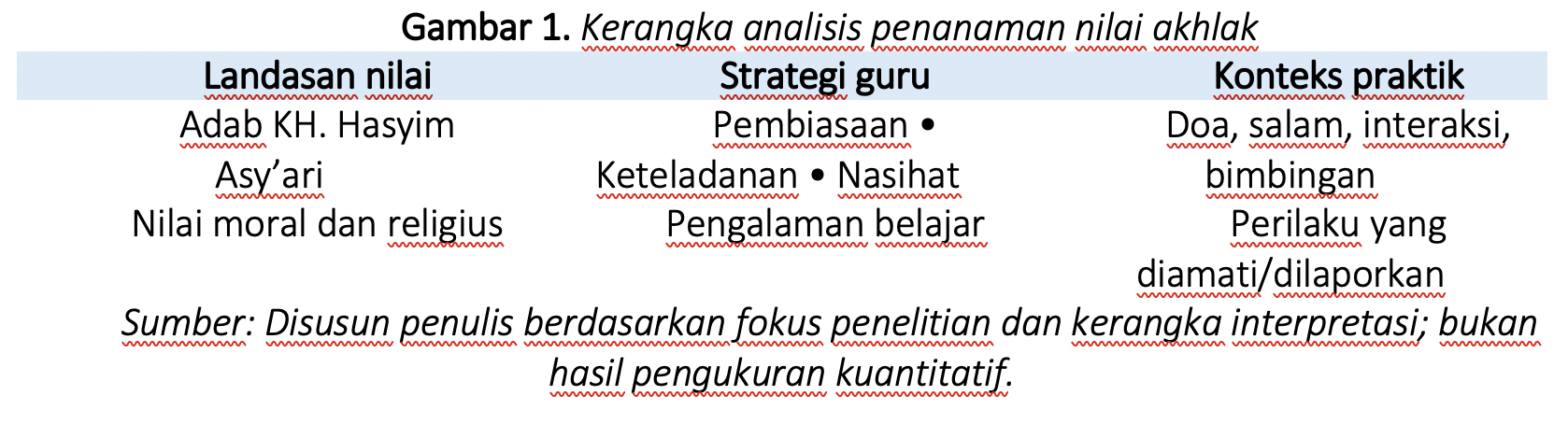
This study examines the strategies employed by Islamic Religious Education (PAI) teachers to foster students’ moral character in light of the educational thought of KH. Hasyim Asy’ari at SDN Gunung Sekar 4 Sampang, Indonesia. It aims to describe the strategies used by the teacher, explain how they are implemented in classroom activities and students’ daily routines, and identify the factors that support or hinder the process. The study adopted a descriptive qualitative approach and was conducted as field research. Data were collected from one PAI teacher through two rounds of interviews and direct classroom observation. The data were then analyzed descriptively according to the research focus. The findings show that moral education is promoted through religious routines, teacher role modeling, and advice. These practices are reflected in students’ habits of praying, reciting short Qur’anic surahs, greeting others, speaking politely, sharing learning materials, and respecting their peers. Religious routines and the use of digital media to present stories of the prophets and examples of commendable conduct serve as supporting factors. However, differences in students’ personalities, family backgrounds, and exposure to inappropriate digital content pose challenges to this process. The findings highlight the importance of consistent role modeling, habituation, and teacher guidance in moral education. Nevertheless, the findings should be interpreted within the study’s limited context, as the research involved only one PAI teacher at a single school.
Downloads
Downloads
Published
Issue
Section
License
Copyright (c) 2026 Fadia, Nur khomisatul Laili, Restu Bagus Suherman, Emna Laisa (Author)

This work is licensed under a Creative Commons Attribution 4.0 International License.
This journal provides immediate open access to its content under the Creative Commons Attribution 4.0 International License (CC BY 4.0). This license permits unrestricted use, distribution, and reproduction in any medium, provided the original work is properly cited.