Discovery Learning dalam Pembelajaran Pendidikan Agama Islam: Sintaks, Potensi, dan Tantangan Implementasi
DOI:
https://doi.org/10.65941/g7bg1x21Abstract
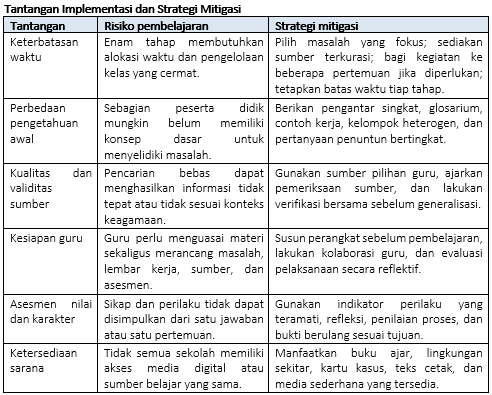
Islamic Religious Education (IRE) is expected to develop not only students’ knowledge of religious concepts but also their capacity to interpret values and relate them to everyday conduct. Teacher-centred instruction and memorisation may limit opportunities for inquiry, discussion, and contextual understanding. This article examines how Discovery Learning can be conceptually designed for IRE by clarifying its learning principles, describing its six instructional phases, and analysing its pedagogical potential and implementation challenges. The study employs a qualitative library-research design. Its materials comprise foundational works on discovery and inquiry learning, instructional-design literature, and published studies on Discovery Learning in IRE. Data were collected through document review and analysed through thematic content analysis and descriptive synthesis. The analysis indicates that the six phases of stimulation, problem statement, data collection, data processing, verification, and generalization can provide a structured sequence for inquiry in IRE. The phases need to be adapted to the epistemic character of each topic and supported by teacher guidance, credible religious sources, differentiated scaffolding, and assessment of knowledge, attitudes, and practices. Discovery Learning therefore should not be equated with unguided exploration or treated as a guaranteed method for producing character change. The article proposes a conceptual design that links inquiry activities with evidence-based interpretation and reflective application of Islamic values. Its contribution is a topic-sensitive design framework, rather than an empirical claim about classroom effectiveness
Downloads
Downloads
Published
Issue
Section
License
Copyright (c) 2026 Nuraini Afiah, Muhammad Asbanur Hakiky, Nayla Qonita Diana, Muhammad Farhan (Author)

This work is licensed under a Creative Commons Attribution 4.0 International License.
This journal provides immediate open access to its content under the Creative Commons Attribution 4.0 International License (CC BY 4.0). This license permits unrestricted use, distribution, and reproduction in any medium, provided the original work is properly cited.