Desain Problem Based Learning dalam Pembelajaran Pendidikan Agama Islam:Integrasi Nilai-Nilai Islam dan Keterampilan Berpikir Kritis
DOI:
https://doi.org/10.65941/6ev7m032Keywords:
Problem-Based Learning, Islamic Religious Education, Critical Thinking, Islamic Values, Conceptual Instructional DesignAbstract
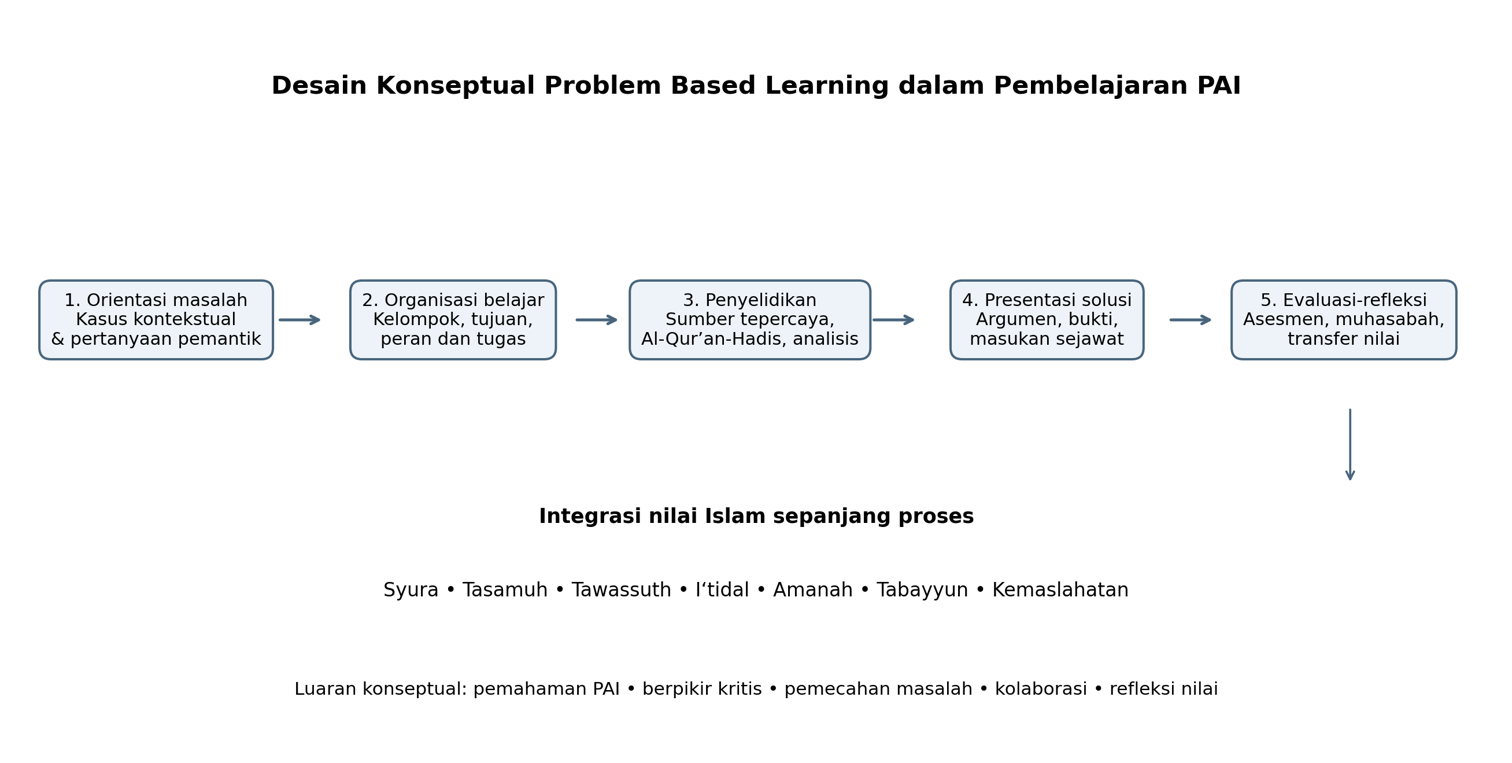
This article develops a conceptual design of Problem-Based Learning (PBL) for Islamic Religious Education (PAI) by integrating Islamic values and critical-thinking practices. The study responds to concerns that PAI instruction may become overly dependent on teacher explanation and memorization when learning tasks are detached from students’ social experiences. The article employs library research. Relevant books and scholarly publications on PBL, constructivist learning, critical thinking, and Islamic education are examined through thematic content analysis. No field observation, interview, expert validation, classroom implementation, or product trial was conducted. The synthesis proposes a five-stage instructional design: problem orientation, learner organization, guided investigation, presentation of proposed solutions, and evaluation-reflection. Islamic values, including syura, tasamuh, tawassuth, i‘tidal, amanah, and tabayyun, are integrated across the stages rather than treated as a separate closing activity. The design also specifies teacher and learner roles, learning resources, assessment evidence, and safeguards for selecting contextual problems. The article argues that PBL can provide a structured opportunity for learners to identify problems, assess information, construct arguments, consider Islamic sources responsibly, and reflect on the ethical implications of solutions. Because the design has not been empirically tested, its validity, practicality, and effectiveness remain questions for subsequent development and field research
Downloads
Downloads
Published
Issue
Section
License
Copyright (c) 2026 Muhammad Romi Rivaldy, Mujiburrahman, Nur Holifa, Nur Halimatus Sa’diyah, Novi (Author)

This work is licensed under a Creative Commons Attribution 4.0 International License.
This journal provides immediate open access to its content under the Creative Commons Attribution 4.0 International License (CC BY 4.0). This license permits unrestricted use, distribution, and reproduction in any medium, provided the original work is properly cited.