Kompetensi dan Profesionalisme Guru dalam Pembelajaran Pendidikan Agama Islam: Kajian Teoretis
DOI:
https://doi.org/10.65941/ja8n2h14Keywords:
Islamic Religious Education, Teacher Competence, Teacher Professionalism, PAI Teacher, Learning TheoryAbstract
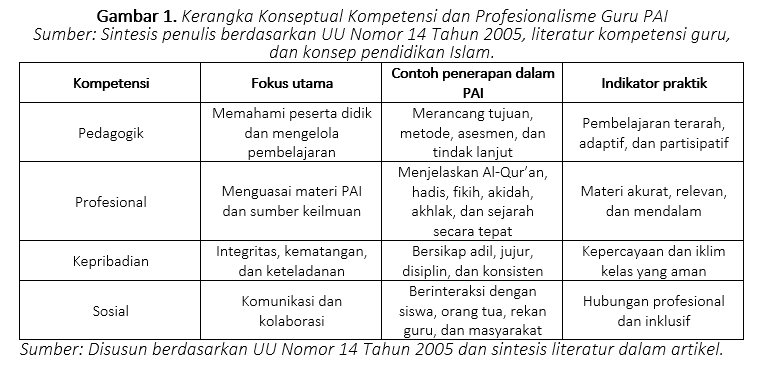
This article examines the competencies and professional roles of Islamic Religious Education (PAI) teachers through a theoretical literature review. The study discusses learning theories relevant to PAI, the four statutory teacher competencies, the position of teachers in Islamic educational thought, their roles and responsibilities, and current professional challenges. The review draws on books, scholarly articles, and Indonesian education regulations. The literature is analyzed thematically by identifying key concepts, comparing perspectives, and synthesizing their implications for PAI teaching. The discussion indicates that effective PAI teaching requires the integration of pedagogical, professional, personal, and social competencies. These competencies become meaningful when translated into lesson planning, accurate subject-matter explanation, inclusive classroom interaction, assessment across cognitive, affective, and psychomotor domains, and consistent role modelling. Islamic educational concepts such as murabbi, mu'allim, and mursyid enrich the understanding of the teacher’s moral and formative responsibilities, but they should complement rather than replace the professional standards established by national regulation. The article also identifies challenges related to digital information, student diversity, learning motivation, and continuous professional development. It concludes that teacher professionalism in PAI is a sustained integration of knowledge, pedagogical judgement, ethical conduct, social competence, and reflective practice
Downloads
Downloads
Published
Issue
Section
License
Copyright (c) 2026 Moh Rayhan Ramadhan, Mohammad Fannani, Novia Agustin, Qistiatul Mubarokah, Qomariyatul Badriyah (Author)

This work is licensed under a Creative Commons Attribution 4.0 International License.
This journal provides immediate open access to its content under the Creative Commons Attribution 4.0 International License (CC BY 4.0). This license permits unrestricted use, distribution, and reproduction in any medium, provided the original work is properly cited.