Epistemologi Pendidikan Agama Islam Dalam Era Digital
Keywords:
Epistemology, Islamic Religious Education, Digital Era, Critical LiteracyAbstract
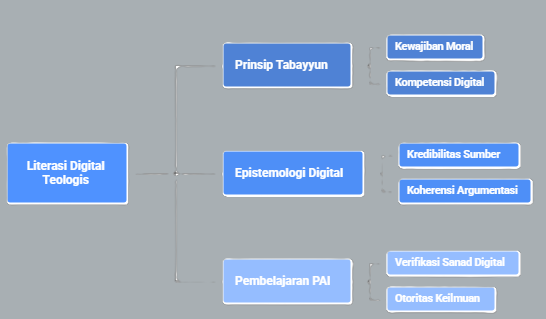
The digital era has transformed the epistemic landscape of Islamic Religious Education (PAI), marked by the coexistence of traditional religious authority and an overwhelming flow of unfiltered digital information. This study aims to reconstruct the epistemological framework of PAI to preserve the validity, authenticity, and relevance of Islamic knowledge in the context of technological disruption. Employing a descriptive qualitative approach through library research, this study analyzes contemporary literature on the philosophy of science, Islamic epistemology, and digital education. The findings indicate that the epistemology of PAI in the digital era must adopt an integrative–interconnective model that synthesizes the bayani (textual), burhani (rational), and irfani (intuitive) modes of reasoning, reinforced by critical digital literacy. Religious knowledge is no longer positioned as a static and monologic transmission of texts but emerges through a dynamic interaction between sacred sources and data-driven sociocultural realities. The study concludes that strengthening digital source criticism and tabayyun-oriented learning is essential to enhance students’ epistemic resilience against hoaxes, misinformation, and religious radicalism. This epistemological reconstruction is crucial for positioning PAI as a moral compass and intellectual foundation within an increasingly complex digital ecosystem
Downloads
Downloads
Published
Issue
Section
License
Copyright (c) 2025 Moh. Zainail Arifin, Ainur Rofiq Sofa (Author)

This work is licensed under a Creative Commons Attribution 4.0 International License.
This journal provides immediate open access to its content under the Creative Commons Attribution 4.0 International License (CC BY 4.0). This license permits unrestricted use, distribution, and reproduction in any medium, provided the original work is properly cited.