
Desain dan Model Manajemen Pembelajaran Pendidikan Agama Islam Dalam Meningkatkan Mutu Pembelajaran
Keywords:
Learning Design, Learning Management, Islamic Religious EducationAbstract
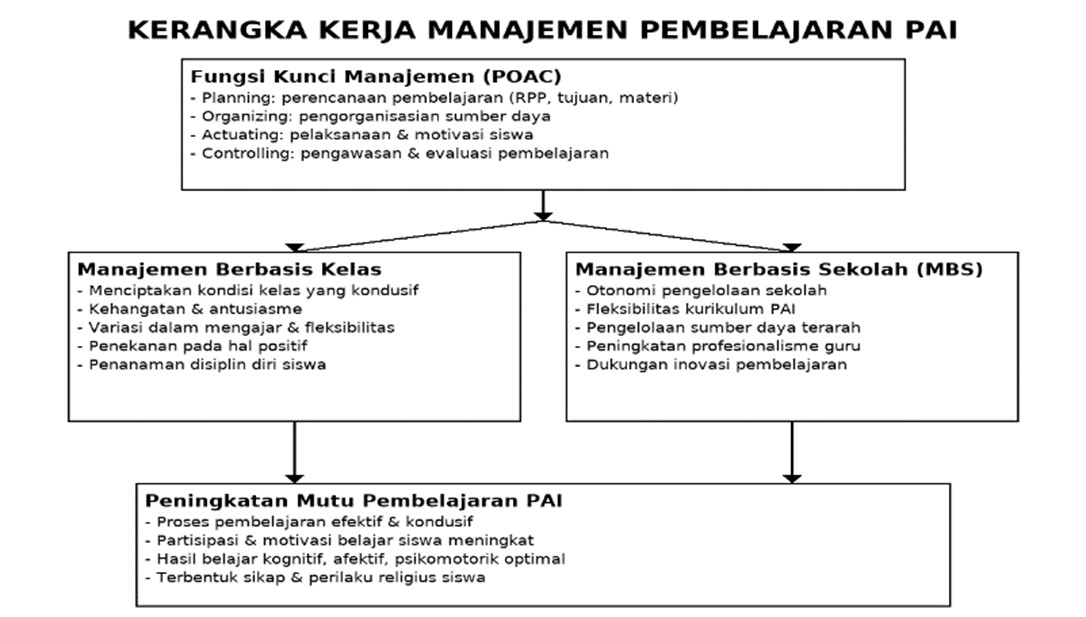
This article presents a comprehensive analysis of the design and management models of Islamic Religious Education (PAI) learning in public schools and madrasahs in Indonesia. The main objective is to examine relevant paradigms, models, and management frameworks in efforts to improve the quality of Islamic Religious Education (PAI) learning. This research uses a literature review method with a descriptive qualitative approach, collecting data from various scientific journals, books, and related research documents. The results and discussion indicate that PAI learning design must shift from knowledge transmission to personality transformation, by integrating Islamic values and modernity. A comparative analysis of the ADDIE and ASSURE instructional design models shows that both have a synergistic role, with ADDIE suitable for macro-scale program development and ASSURE effective for micro-level teaching and learning planning. In terms of management, the POAC framework and the Classroom-Based Management and School-Based Management models are key to creating an effective learning ecosystem. The comparative study between public schools and madrasahs highlights fundamental differences in curriculum structure, time allocation, and material depth, which have implications for different learning orientations and outcomes. This article also discusses challenges and innovations in the digital era, such as digital transformation and the adoption of innovative learning approaches. In conclusion, a series of strategic recommendations are formulated for educators, institutional managers, and policy makers to encourage continuous improvement in the quality of Islamic Religious Education learning
Downloads
Downloads
Published
Issue
Section
License
Copyright (c) 2025 Muhammad Ubaidillah, Salam Zilsafil, La Ode Muhammad Rizky Ramadan, Muh. Okasa Firdausi, Muhammad Daniel Maulana, Muhammad Bayu Abdillah (Author)

This work is licensed under a Creative Commons Attribution 4.0 International License.
This journal provides immediate open access to its content under the Creative Commons Attribution 4.0 International License (CC BY 4.0). This license permits unrestricted use, distribution, and reproduction in any medium, provided the original work is properly cited.