
Manajemen Pembelajaran PAI Melalui Project Based Learning Dalam Membangun Kreatifitas Siswa
Keywords:
Learning Management, Islamic Religious Education, Project Based LearningAbstract
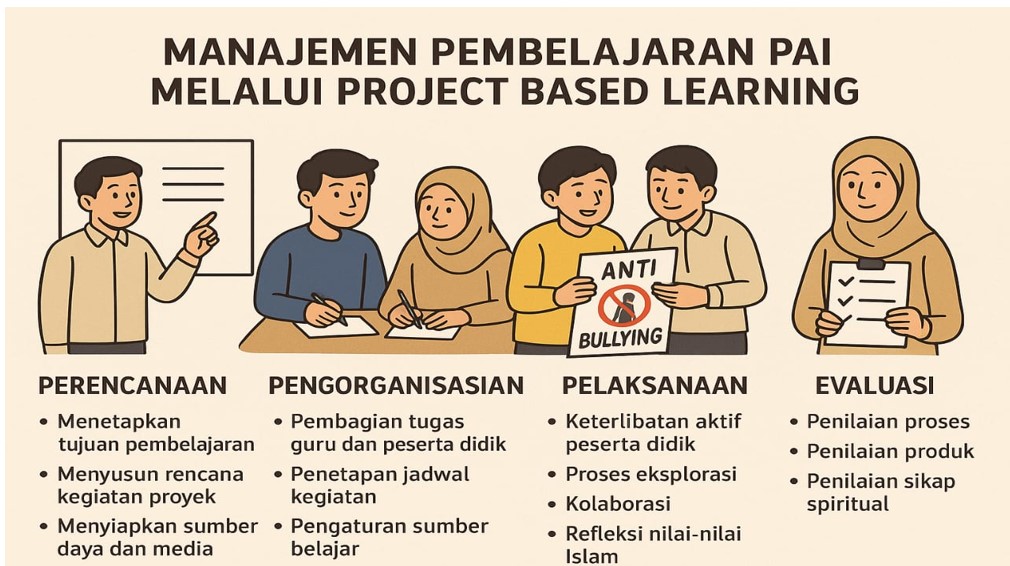
The purpose of this study is to analyze the management of Islamic Religious Education (PAI) learning through the Project-Based Learning (PjBL) approach, covering the aspects of planning, organizing, implementing, and evaluating. This research employs a descriptive qualitative method with data collected through observation, interviews, and documentation. The findings indicate that the planning of project-based PAI learning is carried out by setting contextual learning objectives, designing project activity plans, and preparing necessary resources and supporting media. The organizing stage involves assigning roles to teachers and students, determining activity schedules, and arranging learning resources to ensure an effective learning process. The implementation of PjBL focuses on the active engagement of students in exploring, collaborating, and reflecting on Islamic values through projects that are relevant to real-life contexts. Meanwhile, the evaluation is conducted continuously by assessing the process, the project outcomes, and students’ spiritual attitudes using authentic assessment instruments. Thus, the management of PAI learning through Project-Based Learning has proven effective in enhancing students’ independence, creativity, and contextual understanding of Islamic teachings.
Downloads
Downloads
Published
Issue
Section
License
Copyright (c) 2025 Muhammad Hasan Rizqi Maulana, Moh. Iqbal, Nur Muhammad Iskandar, Moh. Abdillah Zainul Qurry, Moh. Dicky Mirqotul Ulum (Author)

This work is licensed under a Creative Commons Attribution 4.0 International License.
This journal provides immediate open access to its content under the Creative Commons Attribution 4.0 International License (CC BY 4.0). This license permits unrestricted use, distribution, and reproduction in any medium, provided the original work is properly cited.